AI Car Photo Editing vs Photoshop: Honest Comparison
ModDrip Team · 2026-08-06 · 4 min read
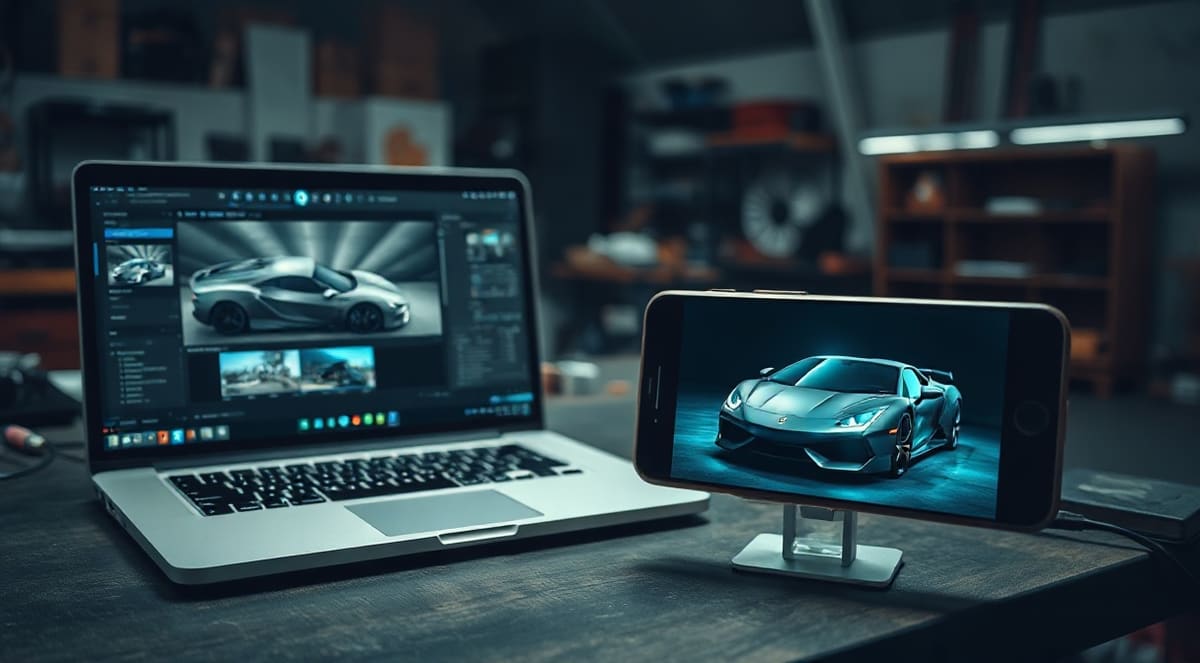
AI car editing wins on speed, cost and accessibility — a realistic wheel or wrap change in 15-30 seconds with zero skill required — while Photoshop still wins on pixel-perfect control, exact-part accuracy and print-grade composites. For "how would my car look with X?", AI is now clearly the better tool; for rendering a specific branded part with millimeter accuracy, a skilled Photoshop artist still has the edge.
We build an AI tool, so take our fairness seriously: this comparison includes the cases where you shouldn't use us.
How do they compare on time and skill?
This is the least close part of the contest. A competent virtual-tuning job in Photoshop — masking the car, warping a wheel photo into perspective, matching light and reflections — takes an experienced artist 1-4 hours and a beginner far longer, after months of learning masks, blend modes and transform tools. An AI edit takes seconds and the learning curve is "upload a photo, pick a style."
- Photoshop: hours per realistic edit, significant skill floor, endless control ceiling.
- AI (e.g. ModDrip): ~15-30 seconds per generation, no skill floor, control via style options and a free-text custom prompt.
- Hiring a virtual tuner: typically $20-100+ per rendered image on freelance marketplaces, with days of turnaround.
What does each actually cost?
Photoshop runs on subscription (roughly $10-25/month depending on plan and region, via Adobe) — but the real cost is your time or an artist's fee. ModDrip's free tier gives 5 credits at signup and 3 generations a day at 720p with a watermark; the paid plan is $9.99/month for 75 credits with HD output, no watermark and all styles (pricing here). For the "preview a mod before buying it" use case, one month of either tool is cheaper than a single mistake at the wheel shop.
Where does Photoshop still win?
An honest list, because these matter:
- Exact parts: if you need that specific brand's wheel in that specific spec on your car, compositing the manufacturer's actual product photo is more literal than any AI style. AI tools render styles convincingly, not catalog SKUs.
- Pixel-level control: repositioning a reflection, fixing one highlight, editing a badge — surgical work is Photoshop's home turf.
- Print and commercial delivery: layered files, CMYK, client revisions on specific pixels.
- Compositing beyond the car: swapping your car into an entirely different photograph with full manual control.
And AI's honest limitations: results vary between generations, fine text and complex logos can render imperfectly, and an AI preview is a visualization — not a fitment guarantee. Always confirm actual parts with the manufacturer.
Where does AI clearly win?
Everywhere the question is exploratory. Comparing five wheel styles, three wrap finishes and two ride heights would be a week of Photoshop work; with ModDrip it's a 15-minute session. Chained editing stacks decisions the way a real build does — wheels, then stance, then wrap — with a thumbnail history to branch from any step, and the before/after slider gives you an instant comparison no layer stack matches for convenience. ModDrip also keeps your car's body, angle and background unchanged, which is precisely the discipline that's hardest to maintain manually. (And unlike files passed around to freelance editors, your uploaded photos are never used to train AI models.)
The practical verdict: use AI to decide, use Photoshop (or a pro) if you later need one perfect, part-exact hero image. Most enthusiasts only ever need the first one. Whichever you choose, results depend heavily on the source image — see how to take the perfect car photo for AI editing.
Can Photoshop's own AI tools do car mods?
Photoshop now includes generative AI features, and they're genuinely useful for backgrounds and object removal. For car-specific edits like wheels, stance and wraps, purpose-built tools still produce more consistent automotive results because they're constrained to preserve the car's identity.
Is AI car editing realistic enough to make buying decisions?
For style decisions — color, finish, wheel design, ride height, body kit direction — yes, that's exactly what it's for. For technical decisions like offset, tire size and part compatibility, no preview replaces checking specs with the manufacturer or your installer.
Which is cheaper for a one-off preview?
AI, by a wide margin. ModDrip's free tier covers a handful of previews at no cost, while a single commissioned Photoshop render typically starts around $20-50.
Written by the ModDrip team. Last updated August 2026.